Oak City Blog
Construction Site Restroom Trailer Planning Guide for Contractors
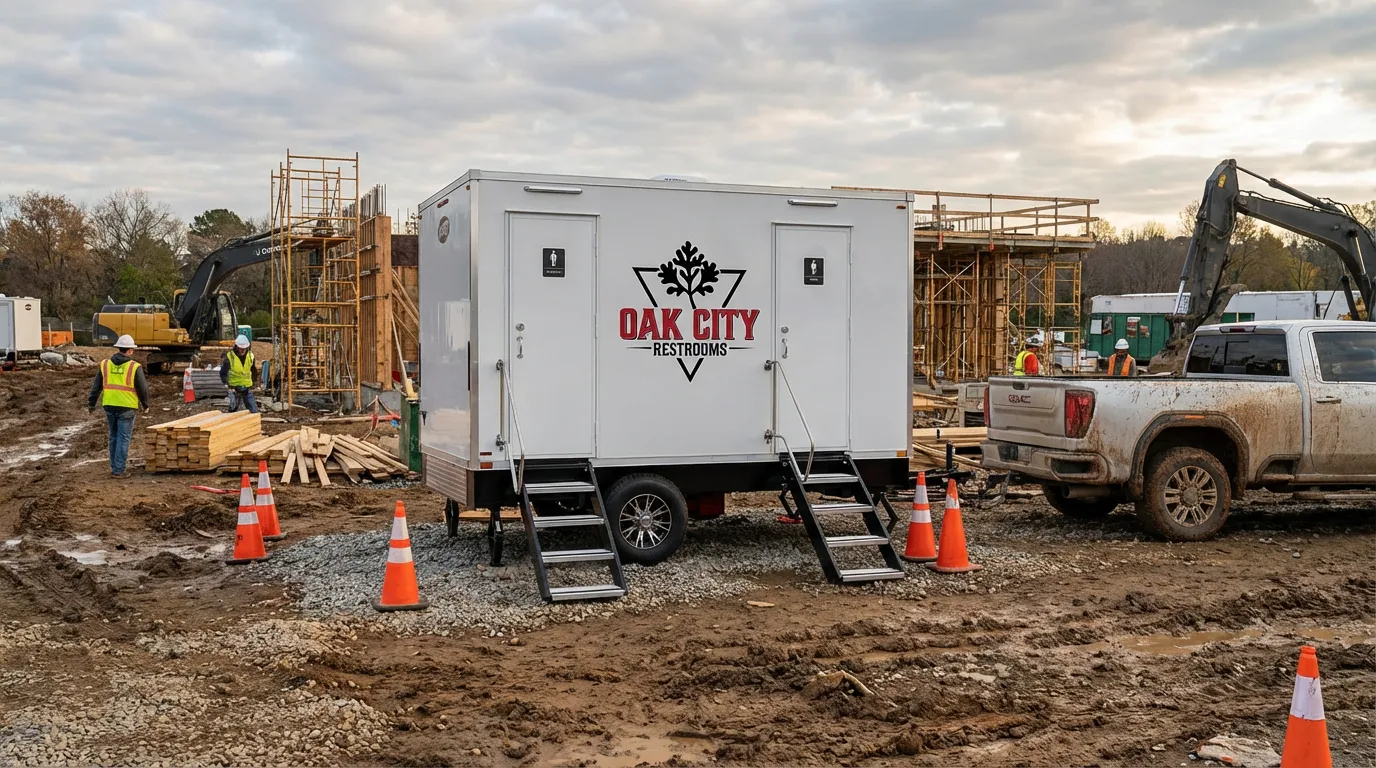
Planning restroom facilities for a construction project is not something most contractors think about until the last minute. But getting it right from the start saves money, keeps your crew productive, and prevents compliance headaches down the road. This guide walks you through the entire planning process for construction site restroom trailers, from deciding whether a trailer is the right fit for your project to scheduling delivery and managing long-term rentals.
If you are a general contractor, site manager, or project planner working in North Carolina, this is the practical roadmap you need before your next project breaks ground.
Get a Free Construction Site Quote
Key Takeaways
- Restroom trailers outperform standard porta potties on projects lasting more than two weeks, on sites with client or inspector visits, and whenever crews exceed 15 workers.
- Site prep is straightforward but must be planned in advance: you need a level surface, a 20-amp electrical outlet within 100 feet, and a water source for running sinks and flushing toilets.
- Long-term rental planning reduces your per-day cost significantly and ensures consistent weekly servicing so you never have to manage restroom maintenance yourself.
When a Restroom Trailer Makes More Sense Than Porta Potties
Not every job site needs a restroom trailer. For a quick two-day demolition with a small crew, a standard porta potty does the job. But there are clear situations where upgrading to a trailer is the smarter decision.
Project Duration Exceeds Two Weeks
On projects that run for several weeks or months, the daily cost of a restroom trailer drops well below what you would spend cycling through porta potty rentals and service calls. Monthly restroom trailer rental rates are significantly lower per day than short-term event rates, and weekly servicing is included at no extra charge. Over a three-month commercial build, the savings add up quickly while your crew gets a dramatically better facility.
Your Crew Is Larger Than 15 Workers
When your site has more than 15 workers, standard porta potties start to show their limitations. Wait times increase, facilities degrade faster between service visits, and odor becomes a real problem in warm weather. A 3-station restroom trailer handles up to 20 workers comfortably, with separate stalls, flushing toilets, and running water that stays cleaner throughout the workday.
For larger crews of 20 to 50 workers, a 4-station trailer or a combination of units gives everyone adequate access without bottlenecks during breaks.
Clients, Inspectors, or Investors Visit the Site
The condition of your job site facilities reflects on your entire operation. When building owners, municipal inspectors, or investors walk the site, a clean restroom trailer with climate control and real plumbing sends a message about your standards. It is a small detail that makes a professional impression, and it is far more effective than apologizing for the state of a porta potty that has been baking in the summer heat.
You Need ADA-Compliant Facilities
If any worker on your crew requires accessible facilities, or if your contract specifies ADA compliance, a standard porta potty will not meet the requirement. Our ADA accessible 3-station trailer provides a wheelchair-accessible suite with a 60-inch turning radius, grab bars, a low-incline ramp, and wide doorways. This is not just about checking a compliance box; it ensures every person on your job site can use the facilities with dignity.
The Job Site Is Remote or Has Limited Infrastructure
On rural or undeveloped sites where there are no permanent restroom facilities nearby, a self-contained restroom trailer is the most practical solution. Our trailers carry their own freshwater and waste tanks, so they operate independently. All you need is an electrical hookup for climate control and lighting. For sites without power, we can discuss generator-compatible setups.
Step-by-Step Rental Planning for Your Project
Planning your restroom trailer rental should happen at the same time you are planning your other site logistics: equipment staging, material deliveries, and crew schedules. Here is how to work through it.
Step 1: Assess Your Crew Size and Project Timeline
Start with two numbers: your peak crew size and your total project duration.
| Peak Crew Size | Recommended Trailer | Why |
|---|---|---|
| 1 to 15 workers | 3-Station Trailer | Adequate capacity with minimal footprint |
| 15 to 25 workers | 3-Station ADA Trailer or 4-Station Trailer | More stations reduce wait times during breaks |
| 25 to 50 workers | 4-Station Trailer or multiple units | High-traffic capacity without bottlenecks |
| 50+ workers | Multiple units | OSHA requires one toilet per 20 workers |
If your crew size fluctuates across project phases, consider adjusting your rental. You might start with one unit during site prep, then add a second when the full crew arrives for framing and finishes.
Step 2: Choose Your Placement Location
Restroom trailers need to be placed strategically on your site. The goal is convenience for your crew without interfering with active work zones, material staging, or equipment paths.
Placement checklist:
- Within a reasonable walk of work areas. OSHA recommends restrooms be accessible within a 10-minute walk. On most construction sites, placing the trailer within 200 to 300 feet of the primary work area works well.
- On level, stable ground. The trailer needs a flat surface. We use leveling blocks for minor grade differences, but avoid soft, muddy, or heavily sloped areas.
- Clear access for the delivery truck. Our trailers are delivered by truck and require a clear path at least 12 feet wide and 30 feet long for positioning. Plan this route before the site gets crowded with equipment and materials.
- Near a power source. Every trailer needs a standard 20-amp, 120-volt electrical outlet within 100 feet for climate control, lighting, and the water heater. If the outlet is farther away, a heavy-duty outdoor extension cord (12-gauge minimum) bridges the gap.
- Close to a water source. A standard garden hose bib within 100 feet connects to the trailer for running water and flushing capability. If no water hookup is available on-site, we can work with you on freshwater tank refill schedules.
Step 3: Schedule Delivery Before Crews Arrive
The ideal delivery window is one to two days before your crew mobilizes. This gives our team time to position and level the trailer, connect power and water, test all systems, and confirm everything is working before anyone needs to use it.
For projects with firm start dates, we recommend booking your trailer at least one to two weeks in advance. During peak construction season in North Carolina (April through October), earlier booking ensures availability.
Step 4: Set Your Servicing Schedule
Every long-term rental includes scheduled servicing. Our standard construction site service is once per week and includes:
- Waste tank pump-out
- Freshwater tank refill
- Full interior cleaning
- Supply restocking (toilet paper, paper towels, soap)
- Systems check (plumbing, lighting, climate control)
For sites with larger crews or heavy daily use, we offer twice-weekly or custom service schedules. You should never need to handle any restroom maintenance yourself; that is our job.
Step 5: Plan for Project Phases and Adjustments
Construction projects rarely stay the same from start to finish. Your restroom needs may change as the project progresses.
Early phase (site prep and foundation): A smaller crew usually means one trailer is sufficient. This is also the phase where site access is easiest for trailer delivery.
Peak phase (framing, mechanical, finishes): Crew sizes typically double or triple. If you started with a 3-station trailer, this may be the time to add a second unit or swap to a 4-station trailer.
Late phase (punch list and closeout): Crews shrink again. You can scale back to one unit or schedule an early pickup to reduce rental costs.
We offer flexible rental terms that accommodate these changes. You are not locked into a fixed configuration for the entire project.
Site Prep Essentials: What Your Job Site Needs
Your site does not need major modifications to accommodate a restroom trailer. But a few preparations ensure a smooth delivery and reliable operation throughout your project.
Electrical Requirements
Our trailers require a 20-amp, 120-volt grounded outlet for the climate control system, interior LED lighting, water heater, and ventilation fans. This is the same type of outlet found on the exterior of most commercial buildings and construction site temporary power panels.
Key electrical details:
- Confirm the outlet is not shared with high-draw equipment (welders, compressors, or saws) that could trip the breaker.
- A GFCI-protected outlet is ideal for outdoor use.
- If your temporary power panel does not have a dedicated outlet, your electrician can add one quickly and inexpensively.
For more detail on power and water connections, see our full restroom trailer setup guide.
Water Connection
A standard garden hose connection provides fresh water for flushing toilets and running sinks. Most construction sites have a water spigot available from the building’s temporary water supply. If your site does not yet have water service, our team can fill the onboard freshwater tank at each service visit.
Surface and Access
The delivery area needs:
- A firm, level surface (gravel, compacted dirt, or pavement)
- A clear path at least 12 feet wide for the delivery truck
- No overhead obstructions (power lines, scaffolding, or tree branches) within the delivery path
- Enough room to position the trailer without blocking equipment access, material staging areas, or emergency vehicle routes
How Long-Term Rentals Save You Money
Short-term or single-event restroom trailer rentals carry a higher daily rate because they include mobilization, setup, and removal costs concentrated over a few days. Long-term construction site rentals spread those costs over weeks or months, which brings your effective daily rate down significantly.
Here is how the economics typically work:
| Rental Duration | Pricing Structure | Servicing Included |
|---|---|---|
| Single event (1 to 3 days) | Higher daily rate | Delivery, pickup, one service |
| Weekly rental | Moderate rate | One service per week |
| Monthly rental | Lowest per-day rate | Weekly servicing included |
| Multi-month project | Custom project pricing | Weekly servicing, flexible adjustments |
For a typical three-month commercial build, monthly rental pricing can save 30 to 50 percent compared to what you would pay for the equivalent duration at weekly rates. And because servicing is built into every long-term rental, there are no surprise maintenance charges.
Contact us for a custom quote based on your specific project timeline and crew size.
OSHA Compliance: What Contractors Need to Know
OSHA Standard 29 CFR 1926.51 sets clear requirements for sanitation on construction sites. Restroom trailers make compliance straightforward because they exceed the minimum standards. For a detailed breakdown of OSHA rules and penalty risks, see our construction site restroom trailer rental guide.
The key requirements for your planning:
- One toilet per 20 workers on a standard work schedule
- Handwashing facilities must be available near restroom facilities (restroom trailers include built-in sinks with running water)
- Facilities must be clean, sanitary, and in working order at all times (weekly servicing keeps you compliant)
- ADA-accessible facilities must be provided when required by your crew composition or contract
By choosing a restroom trailer with scheduled servicing, you are essentially outsourcing your OSHA sanitation compliance to us. We handle the cleaning, maintenance, and supply restocking so you can focus on building.
Common Planning Mistakes to Avoid
After working with hundreds of NC contractors, we have seen a few recurring planning mistakes that are easy to prevent.
Waiting until the last minute to book. Peak season in North Carolina runs from April through October. Booking your trailer two or more weeks before your start date ensures you get the configuration you need when you need it.
Ignoring site access for delivery. If your site fills up with equipment, materials, and scaffolding before the trailer arrives, delivery becomes difficult or impossible. Schedule trailer delivery early in the site setup process, ideally before heavy equipment mobilizes.
Underestimating crew size at peak. Plan for your maximum crew count, not your average. If 40 workers will be on-site during framing even though your average is 20, you need facilities for 40. Adding a second unit for the peak phase is far cheaper than dealing with frustrated crews and potential OSHA issues.
Not planning for power and water. These connections are simple but need to be in place before the trailer arrives. Confirm with your electrical and plumbing subcontractors that a 20-amp outlet and a water spigot will be ready at the trailer location on delivery day.
Frequently Asked Questions
How far in advance should I book a restroom trailer for my construction project?
We recommend booking at least one to two weeks before your desired delivery date. During peak construction season (April through October), booking three to four weeks ahead gives you the best selection of available units.
Can I change my rental configuration mid-project?
Yes. Our rental agreements are flexible. You can add a second unit, swap to a larger trailer, or schedule an early pickup as your project phases change. Just give us a few days notice so we can coordinate logistics.
What happens if the trailer needs repair during my rental?
Our servicing team inspects every system during weekly visits. If an issue comes up between visits, call us and we will dispatch a technician. Routine maintenance and repairs are included in your rental agreement.
Do you deliver and set up the trailer?
Yes. Our team handles delivery, positioning, leveling, and all utility connections. We also handle removal at the end of your rental. You do not need to provide any equipment or labor for setup.
What if my site does not have power or water yet?
For sites without power, we can discuss generator-compatible configurations. For sites without water, we fill the onboard freshwater tank during each weekly service visit. Both situations are common on early-stage construction sites, and we have solutions for each.
Ready to Plan Your Construction Site Restrooms?
Getting restroom planning right is one of the easiest ways to keep your crew happy, your site compliant, and your project running smoothly. At Oak City Restrooms, we work with general contractors and site managers across North Carolina to set up the right restroom configuration for every phase of every project.
Whether you are starting a multi-month commercial build or a shorter renovation, contact us for a free quote and let us handle the planning details. You tell us your crew size, project timeline, and site conditions, and we will recommend the right setup, schedule delivery, and keep everything serviced until the last day of your project.
You can also call us directly at (919) 335-4926 or email rentals@oakcityrestrooms.com.
Need Restrooms for Your Next Event?
We deliver luxury restroom trailers across North Carolina with fast setup and spotless service.